
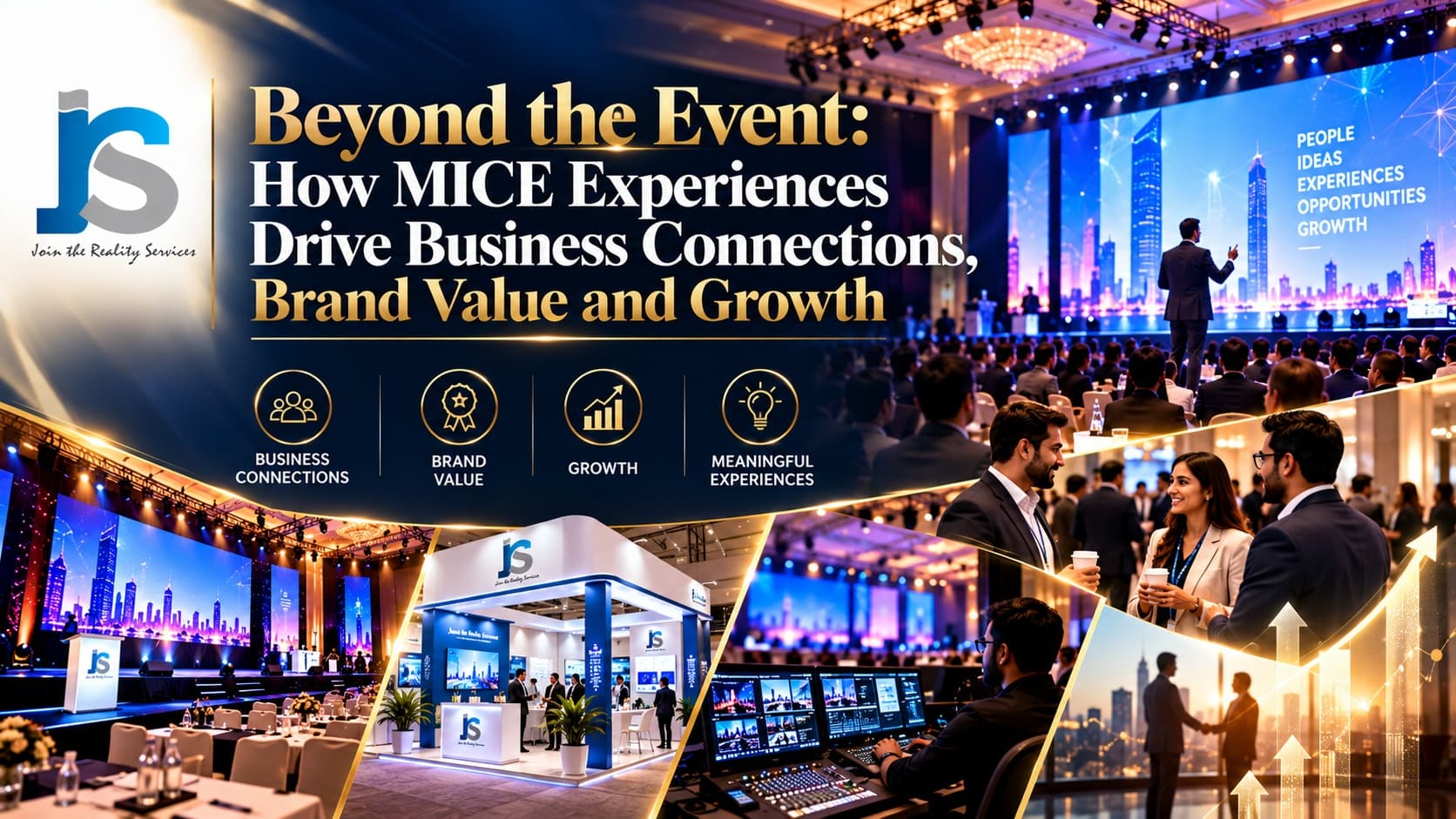
Beyond the Event: How MICE Experiences Drive Business Connections, Brand Value and Growth
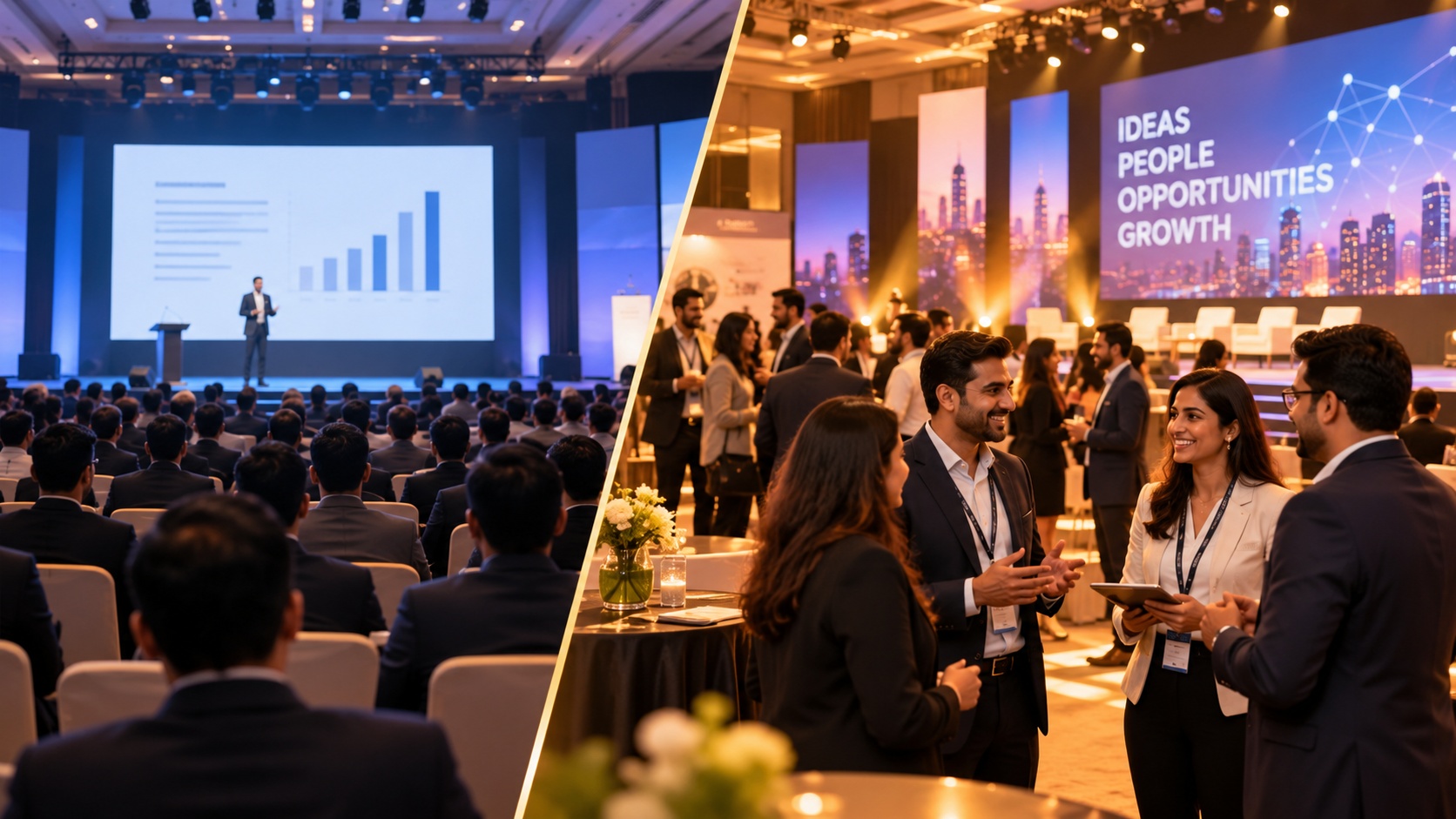
Imagine two corporate conferences.
Both have the same number of attendees, impressive venues, large LED screens and carefully prepared presentations. Both run according to schedule. Yet, after the events end, the outcomes are very different.
At the first conference, attendees listen to presentations, exchange a few business cards and leave.
At the second, they have meaningful conversations, discover new opportunities, engage with the brand and leave with a clearer understanding of the business's vision.
The difference is not necessarily the budget or the size of the venue. It is how the experience has been designed.
This is where MICE event management becomes more than an exercise in organising venues, schedules and logistics. It becomes a way for businesses to create meaningful interactions, communicate their identity and turn gatherings into opportunities.
As companies continue to invest in face-to-face engagement, the question is no longer simply how to organise an event. It is how to make every interaction count.
What Is MICE Event Management, and Why Does It Matter?
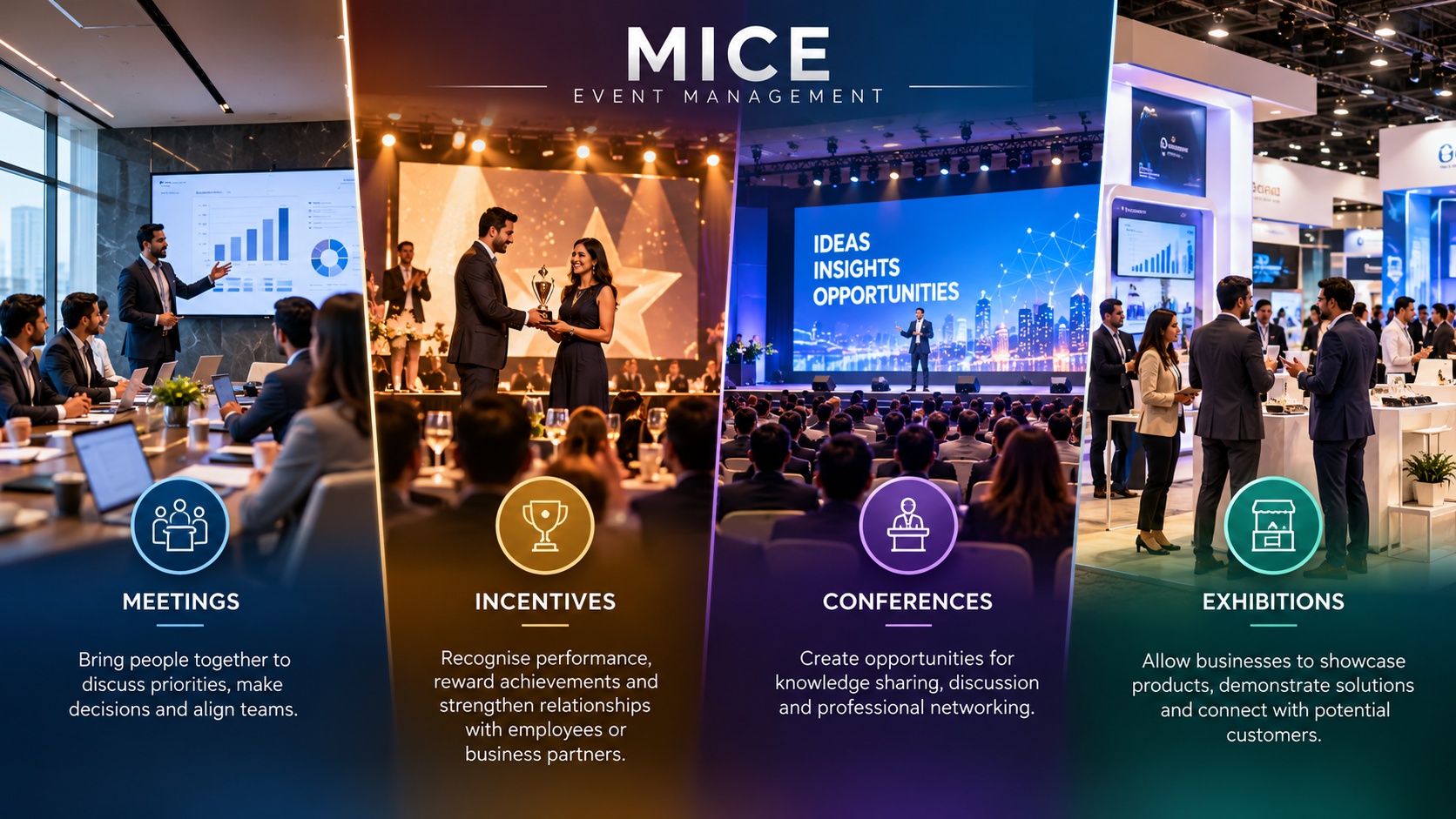
MICE stands for Meetings, Incentives, Conferences and Exhibitions. It brings together four major categories of business events, each serving a different purpose.
Meetings bring people together to discuss priorities, make decisions and align teams.
Incentives recognise performance, reward achievements and strengthen relationships with employees or business partners.
Conferences create opportunities for knowledge sharing, discussion and professional networking.
Exhibitions allow businesses to showcase products, demonstrate solutions and connect with potential customers.
MICE event management involves planning and coordinating these experiences, from the initial concept and venue requirements to production, branding, logistics and on-site execution.
However, the real value lies in understanding why people are gathering in the first place.
A leadership meeting needs clarity and productive discussion. An incentive event needs to make recognition feel meaningful. A conference needs to encourage learning and connection. An exhibition needs to attract attention and make interactions with a brand worthwhile.
The format changes. The objective determines the experience.
The Four Pillars of MICE: Different Events, Different Business Outcomes
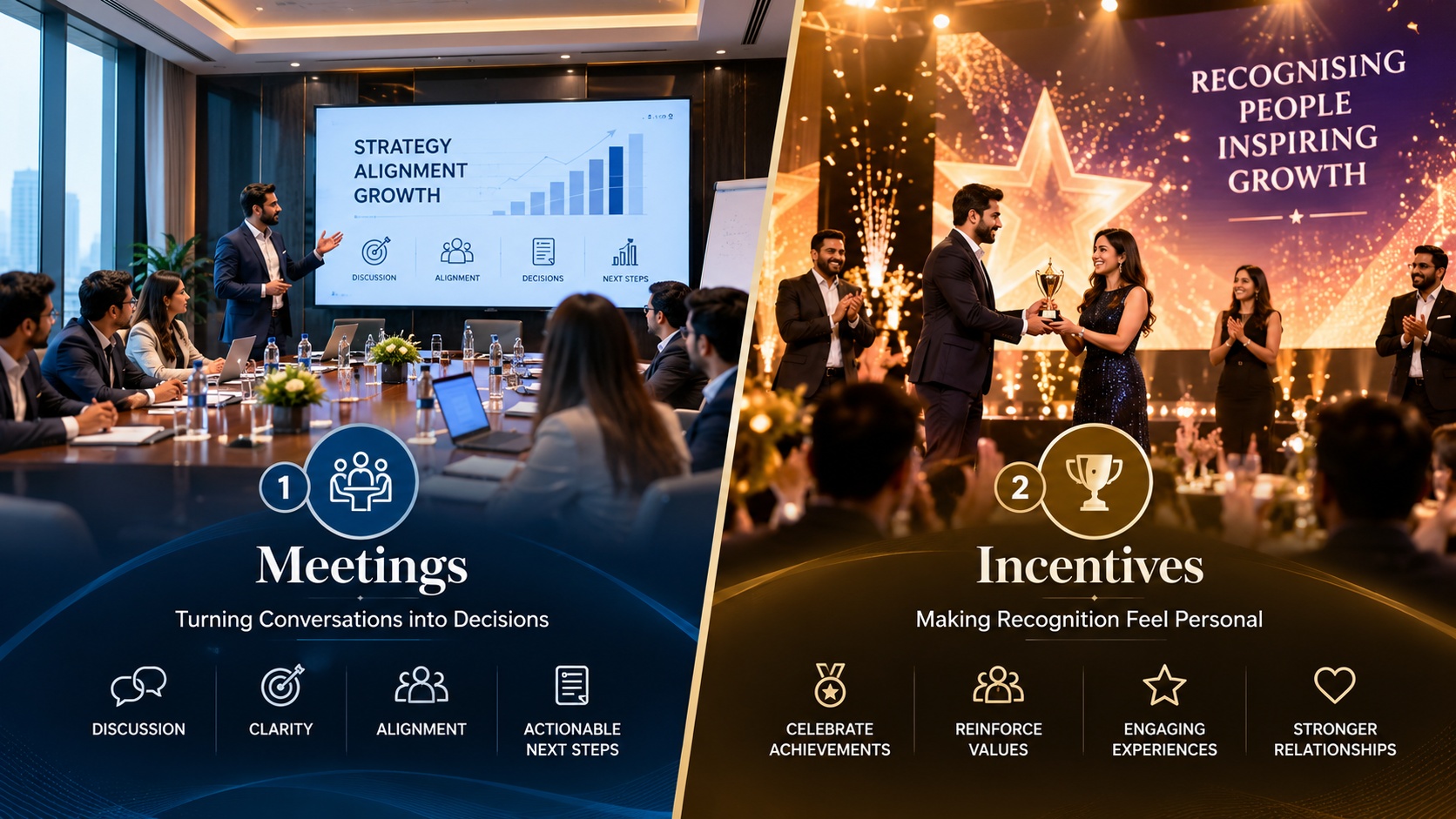
1. Meetings: Turning Conversations into Decisions
A meeting is often considered successful when the agenda is completed on time. But finishing the agenda is only part of the picture.
The more important question is whether participants leave with clarity, alignment and actionable next steps.
Corporate meetings, leadership summits, dealer meets and sales kick-offs all benefit from an environment designed around their purpose.
The seating arrangement, presentation visibility, sound quality, room layout and timing can influence how effectively people participate.
For example, a leadership strategy session may benefit from a collaborative layout that encourages discussion. A large sales kick-off may require a stage, LED displays, clear audio and visual storytelling to communicate targets and priorities.
The principle is simple: the event environment should support the conversation, not compete with it.
2. Incentives: Making Recognition Feel Personal
Recognition is most meaningful when people understand why their contribution matters.
Corporate incentive programmes and Rewards and Recognition (R&R) events provide opportunities to celebrate achievements, acknowledge exceptional performance and reinforce organisational values.
Yet, recognition can lose its impact when the programme becomes a sequence of names, awards and photographs without a compelling story.
Thoughtful event design can change that experience.
Achievement videos, well-planned award presentations, personalised messages, engaging stage visuals and carefully timed moments of recognition can help employees feel that their contributions are genuinely valued.
The objective is not simply to create a grand awards night. It is to make the people being recognised feel like the most important part of the event.
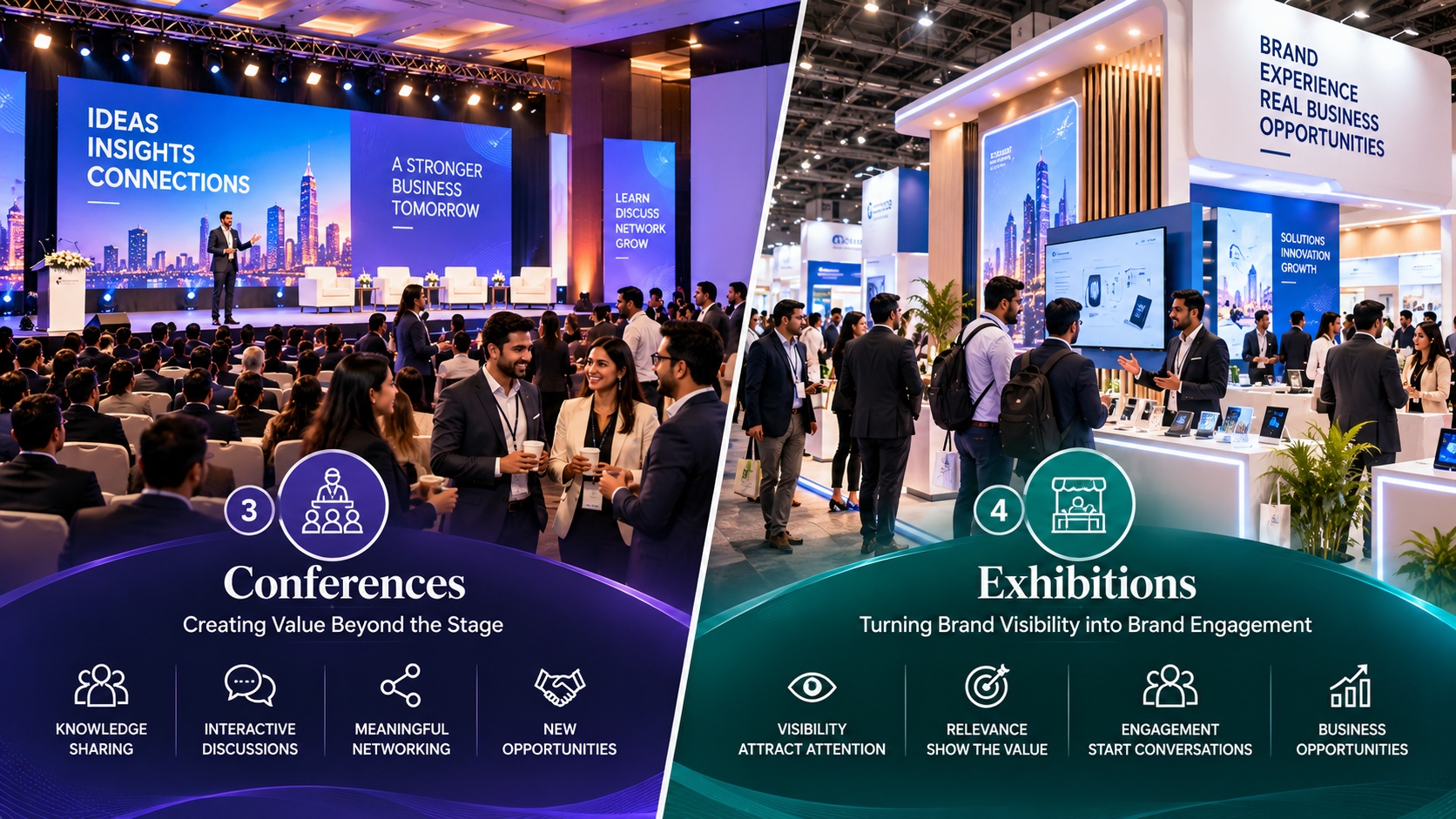
3. Conferences: Creating Value Beyond the Stage
A conference is not defined only by its speakers or presentations. It is also shaped by the conversations that happen between sessions, the questions that challenge existing ideas and the connections attendees make with one another.
A well-planned corporate conference considers the complete attendee journey.
This includes registration, navigation, session scheduling, presentation quality, networking opportunities, refreshments and adequate breaks.
Consider a technology conference where every minute is occupied by presentations. The content might be excellent, but attendees have little opportunity to exchange ideas or explore potential partnerships.
Now consider a programme that combines focused presentations with interactive discussions, demonstrations and purposeful networking.
The second approach creates more opportunities for attendees to participate rather than simply observe.
For event planners, the lesson is important: design for interaction, not just attendance.
4. Exhibitions: Turning Brand Visibility into Brand Engagement
An exhibition stall has a limited window to capture attention in a busy environment.
Visitors may pass dozens of booths in a single hall. A visually impressive structure can help attract their attention, but attention alone does not guarantee a meaningful business interaction.
Effective exhibition planning connects three elements: visibility, relevance and engagement.
Visibility helps visitors notice the brand. Relevance communicates why they should care. Engagement gives them a reason to stop, ask questions, explore a product or begin a business conversation.
This is where exhibition stall design, fabrication, lighting, digital displays and visitor flow work together.
A booth should communicate the brand's proposition quickly, provide space for demonstrations and make conversations comfortable.
The ultimate objective is not merely to build a stall that looks impressive in photographs. It is to create an environment that supports the business purpose of participating in the exhibition.
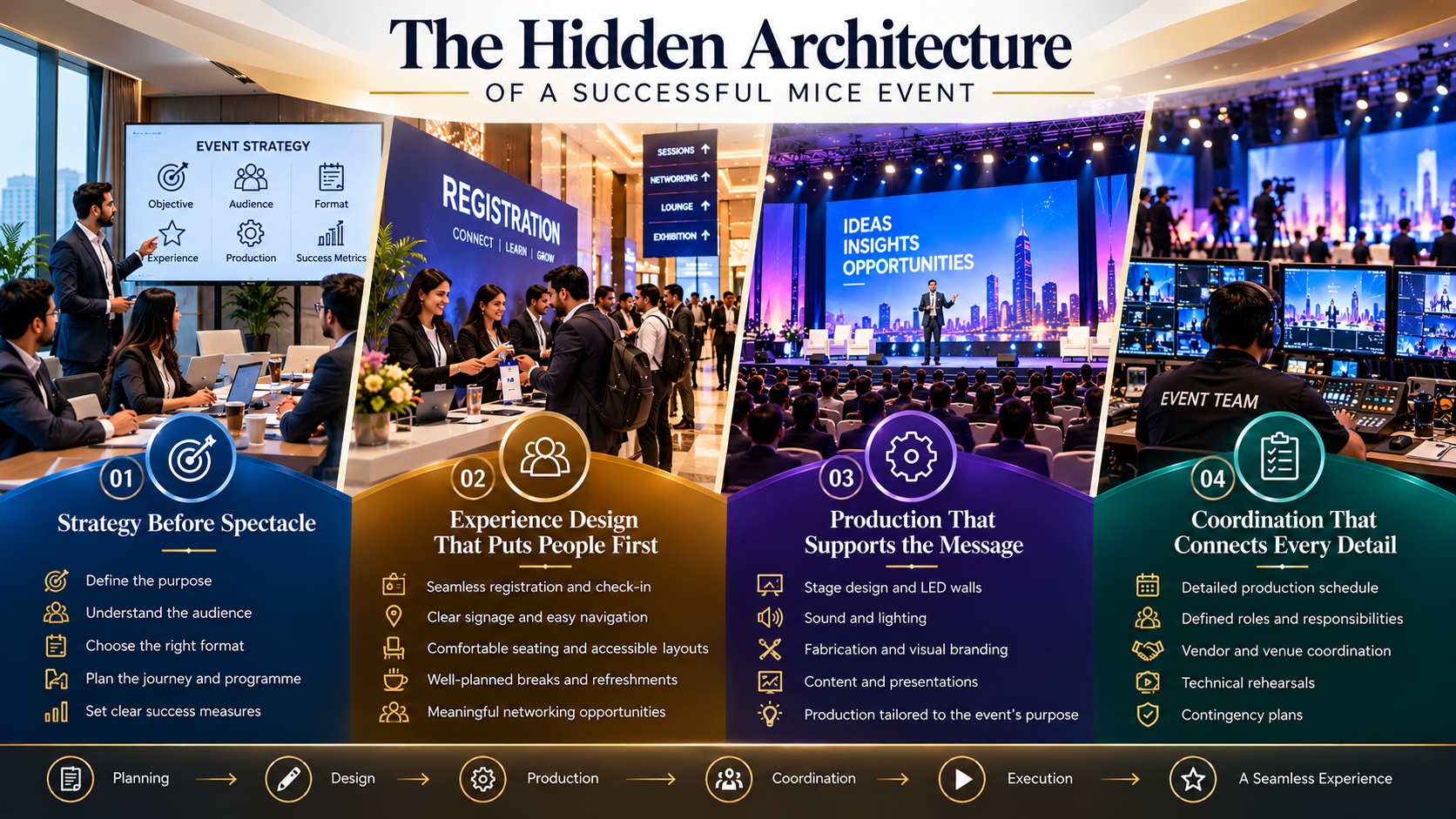
The Hidden Architecture of a Successful MICE Event
What attendees experience as a seamless event is usually the result of decisions made long before the first guest arrives.
Several interconnected elements shape the outcome.
Strategy Before Spectacle
Before selecting a venue or designing a stage, establish the purpose of the event.
Is the priority employee recognition, knowledge sharing, lead generation, partner engagement or internal alignment?
The answer should influence the format, audience journey, programme, production requirements and success measures.
Without this clarity, event planning can become a collection of attractive elements that do not work towards a common objective.
Experience Design That Puts People First
Every attendee moves through a journey: discovering the event, registering, arriving, navigating the venue, participating and eventually leaving.
Friction at any stage can affect the overall impression.
Clear signage, convenient registration, comfortable seating, accessible layouts, appropriate breaks and useful networking opportunities may seem like small details. Together, they influence how people experience the event.
The strongest event designs consider both the moments that attract attention and the practical details that make participation effortless.
Production That Supports the Message
Stage design, LED walls, sound, lighting, fabrication and visual branding are not isolated technical requirements. They are tools for communicating a message.
A product launch may need dramatic visual reveals. A leadership conference may require clean presentation layouts and reliable audio. An awards ceremony may depend on precise lighting and well-coordinated award cues.
The production setup should respond to the event's purpose rather than follow a one-size-fits-all formula.
Coordination That Connects Every Detail
Even an excellent concept can struggle if venue arrangements, vendor deliveries, technical checks and programme timings are poorly coordinated.
A clear production schedule, defined responsibilities, approval timelines and contingency plans help teams manage dependencies.
Technical rehearsals are particularly important for events involving presentations, video playback, multiple speakers or complex stage cues.
The goal is to identify problems before they become visible to the audience.
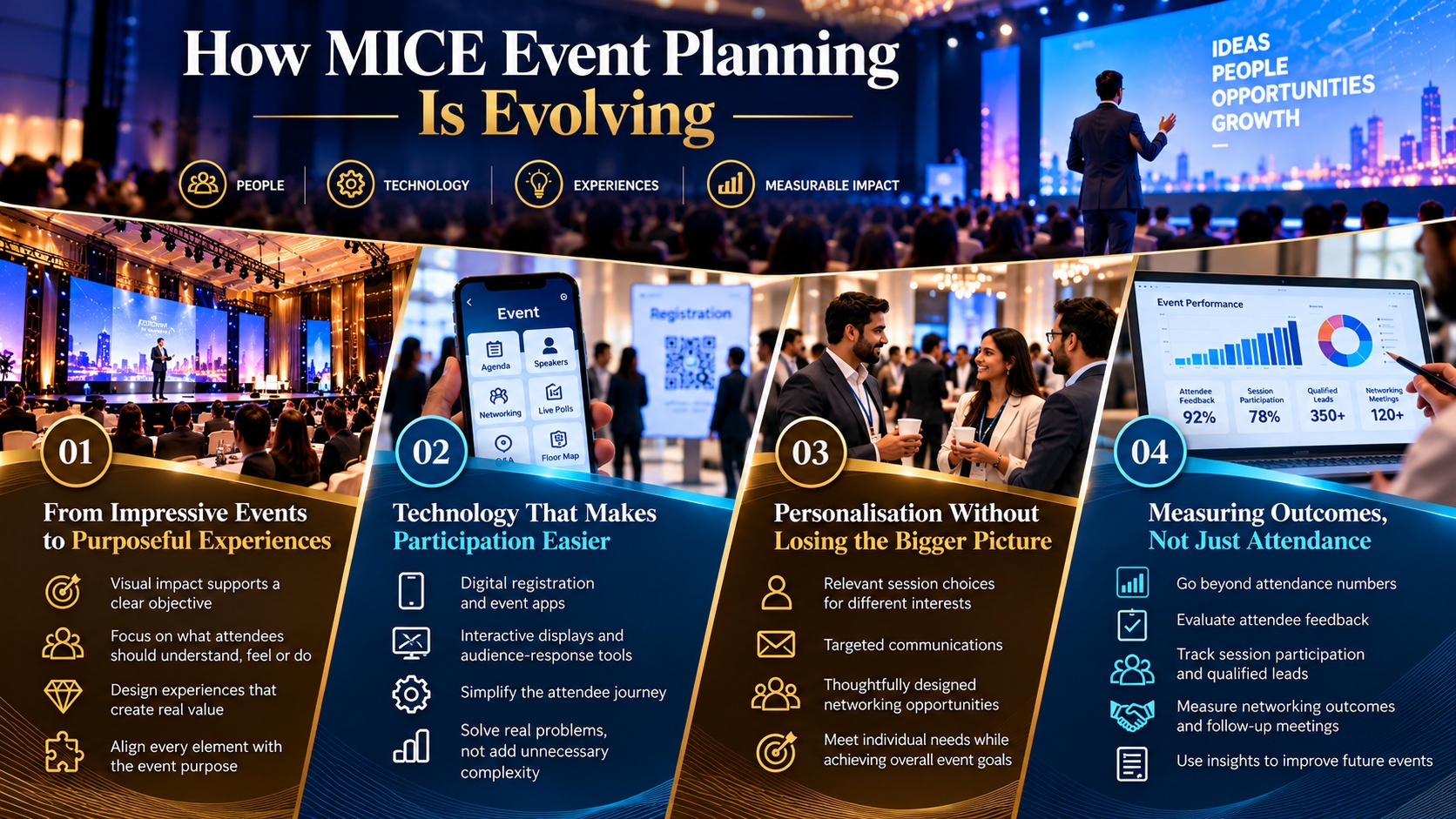
How MICE Event Planning Is Evolving
Modern corporate events are increasingly expected to justify the time and resources invested in them. Event professionals are paying greater attention to attendee connection, intentional experience design, practical technology and measurable outcomes.
For businesses planning their next MICE event, four developments deserve attention.
1. From Impressive Events to Purposeful Experiences
Visual impact remains important, but it should support a clear objective.
Rather than asking only how a stage should look, planners should ask what attendees should understand, feel or do because of the experience.
2. Technology That Makes Participation Easier
Digital registration, event apps, interactive displays and audience-response tools can improve the attendee journey when they solve a genuine problem.
Technology should make participation simpler, not introduce unnecessary complexity.
3. Personalisation Without Losing the Bigger Picture
Different attendees may have different interests, responsibilities and expectations.
Relevant session choices, targeted communications and thoughtfully designed networking opportunities can make an event more useful to its audience.
4. Measuring Outcomes, Not Just Attendance
Attendance numbers tell only part of the story.
Depending on the event objective, businesses can evaluate attendee feedback, session participation, qualified leads, networking outcomes, employee responses or follow-up meetings.
A clear measurement plan makes it easier to understand what worked and where future events can improve.
How to Measure the Business Value of a MICE Event
Before the event begins, identify what success should look like.
The following framework can help.
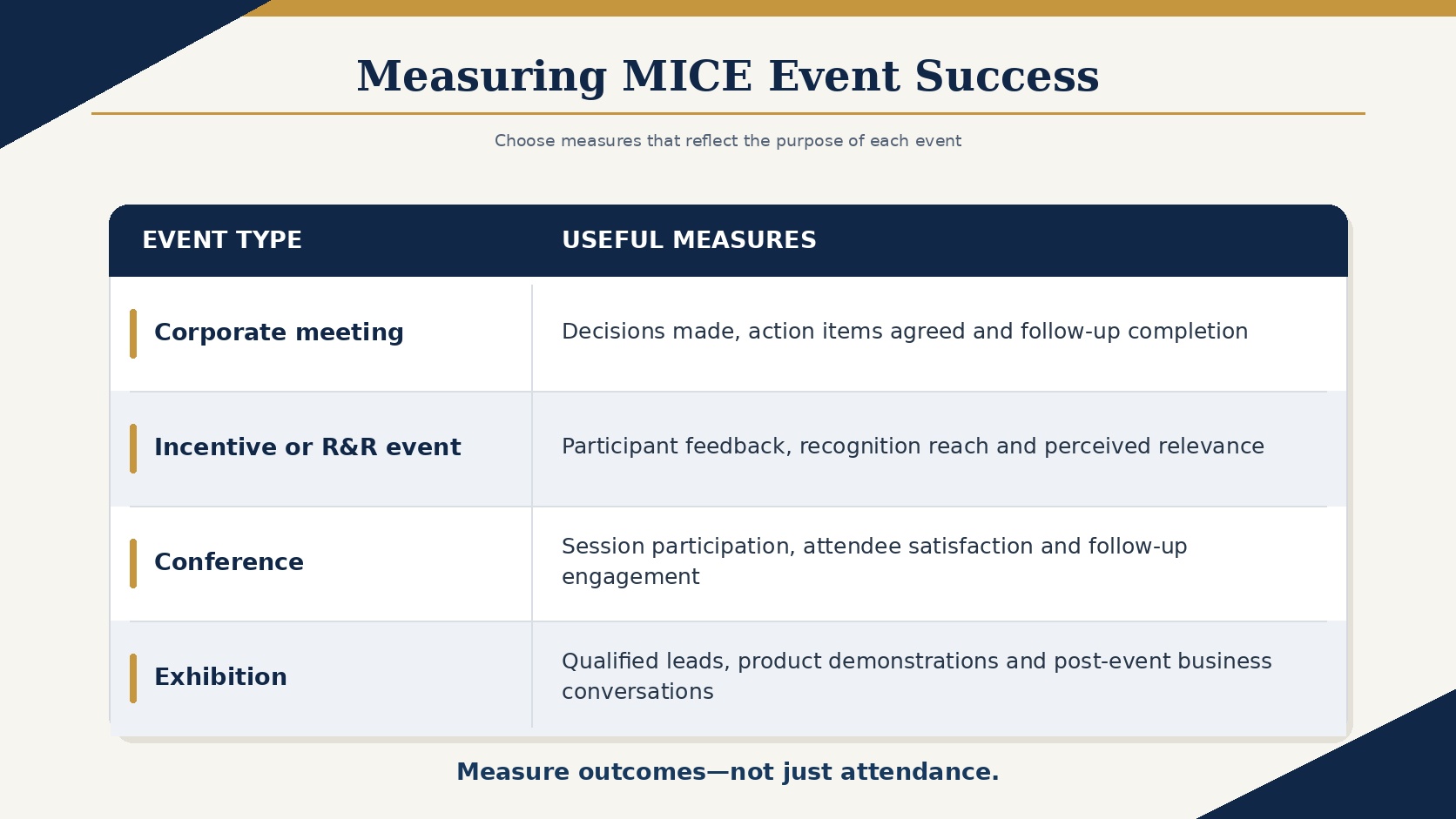
These measures should reflect the event's actual objectives rather than arbitrary targets.
For example, an exhibition designed to generate qualified leads should not be evaluated solely by footfall. Similarly, an internal leadership meeting should not be judged by visual impact alone.
When objectives and measures are defined together, businesses can make more informed decisions about future event investments.
Choosing the Right MICE Event Management Partner
Selecting an event partner involves more than comparing quotations or reviewing photographs of previous stages.
Businesses should evaluate whether the partner understands the event's purpose, can manage the required scope and has the relevant creative, technical and operational capabilities.
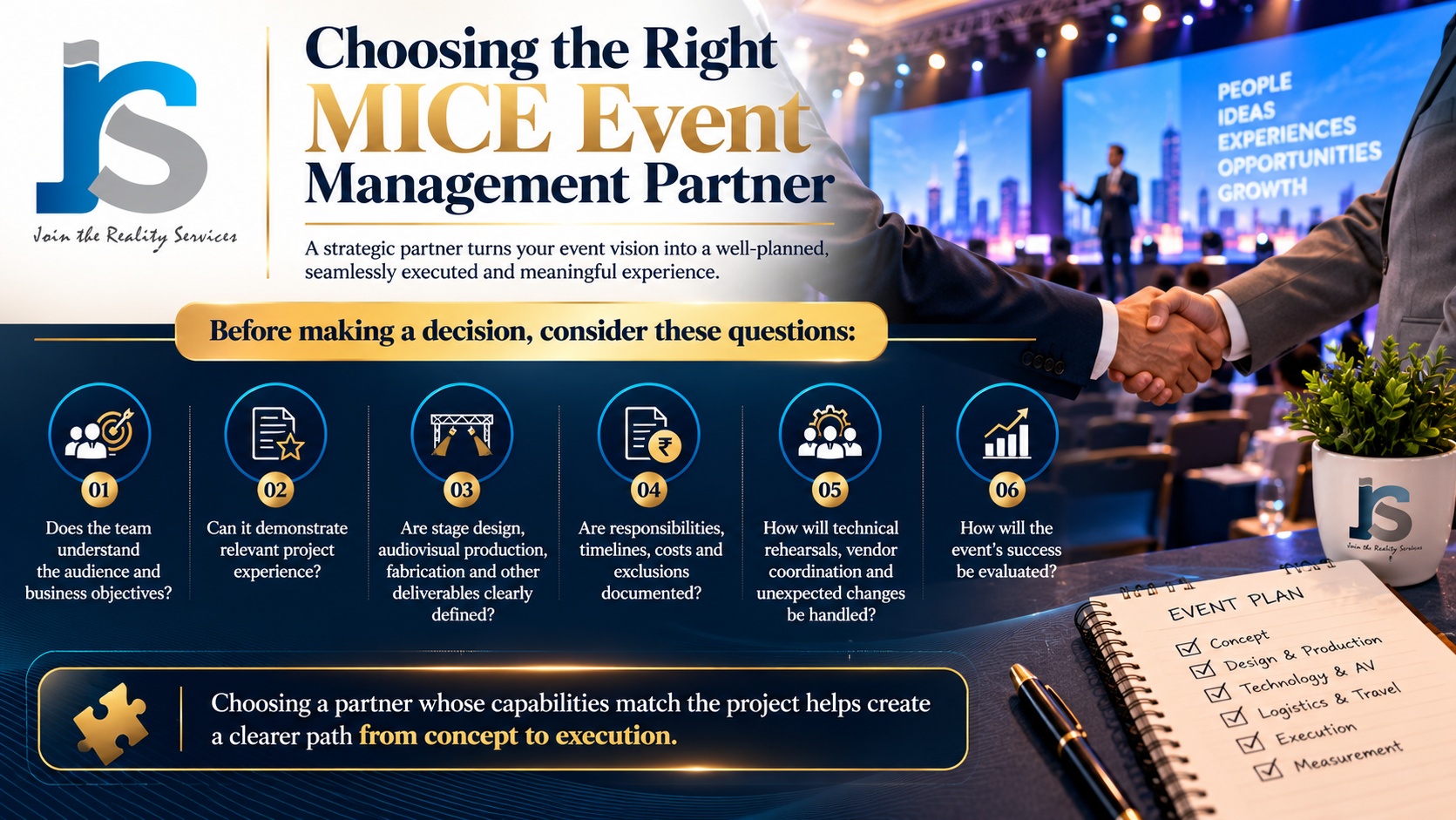
Before making a decision, consider these questions:
Does the team understand the audience and business objectives?
Can it demonstrate relevant project experience?
Are stage design, audiovisual production, fabrication and other deliverables clearly defined?
Are responsibilities, timelines, costs and exclusions documented?
How will technical rehearsals, vendor coordination and unexpected changes be handled?
How will the event's success be evaluated?
It is also important to establish the scope of services. Some providers specialise in event production and fabrication, while others coordinate wider MICE requirements, including travel, accommodation and destination arrangements.
Choosing a partner whose capabilities match the project helps create a clearer path from concept to execution.
Where JRS Creation Fits In
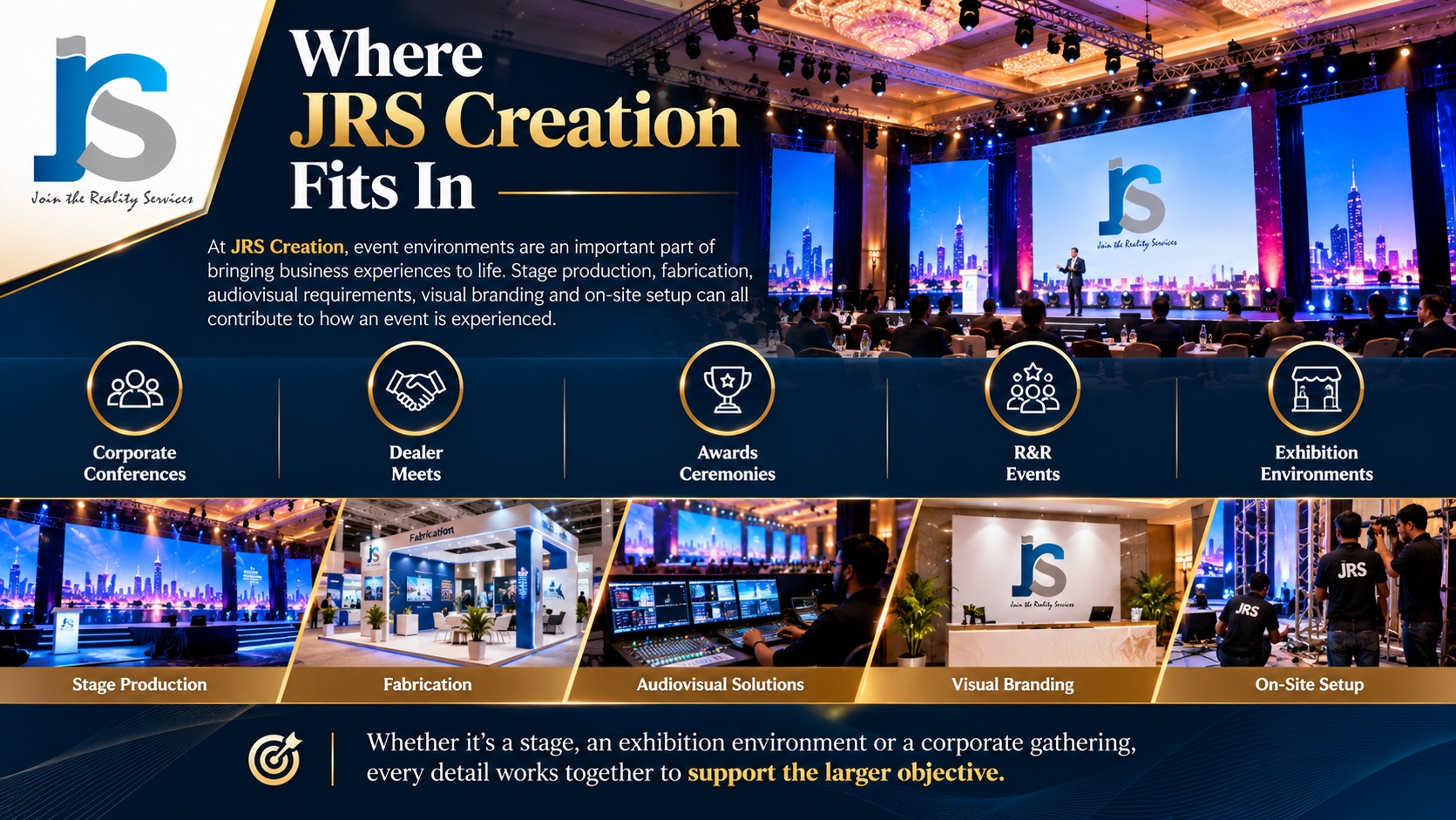
At JRS Creation, event environments are an important part of bringing business experiences to life. Stage production, fabrication, audiovisual requirements, visual branding and on-site setup can all contribute to how an event is experienced.
For businesses planning corporate conferences, dealer meets, awards ceremonies, R&R events or exhibition environments, the starting point should be a clear brief: what needs to happen, who needs to be there and what the event should achieve.
With these priorities established, the creative concept and production requirements can be developed around the needs of the project.
Whether the requirement is a professionally executed stage, an exhibition environment or a corporate gathering, the details should work together to support the larger objective.
Discuss your Event: https://www.jrscreations.net/contact
Final Thought: Make Every Gathering Count
The most memorable business events are not necessarily the biggest or most elaborate.
They are the ones where the purpose is clear, the experience feels considered and people leave with something valuable: a new perspective, a stronger relationship, a recognised achievement or a promising business opportunity.
That is the real opportunity within MICE event management.
When strategy, experience design and execution work together, an event becomes more than a date on the calendar. It becomes an opportunity to move business relationships and ideas forward.
Frequently Asked Questions About MICE Event Management
What does MICE stand for in event management?
MICE stands for Meetings, Incentives, Conferences and Exhibitions. It describes a broad category of business events planned to support communication, recognition, knowledge sharing and commercial engagement.
Why is MICE important for corporate businesses?
MICE events can help organisations strengthen relationships, recognise employees, share knowledge, showcase products and create opportunities for business development. Their value depends on the objectives and the quality of execution.
What services are involved in MICE event management?
Depending on the provider and project scope, services may include event planning, venue coordination, stage design, audiovisual production, branding, fabrication, delegate management and logistics.
How is MICE different from general event management?
MICE specifically focuses on meetings, incentive programmes, conferences and exhibitions. General event management also includes other formats, such as weddings, entertainment events, private celebrations and community gatherings.
How can businesses measure the success of a MICE event?
Businesses can evaluate outcomes such as attendee satisfaction, qualified leads, participation, networking opportunities, employee feedback and progress towards the event's original objectives.
How far in advance should a MICE event be planned?
The timeline depends on the scale, location, venue availability, production complexity and number of participants. Large conferences and exhibitions generally require more preparation than smaller meetings.
What should businesses look for in a MICE event management partner?
Look for relevant experience, a clear scope of work, suitable technical capabilities, transparent pricing, reliable coordination and a practical approach to risk management and event evaluation.