
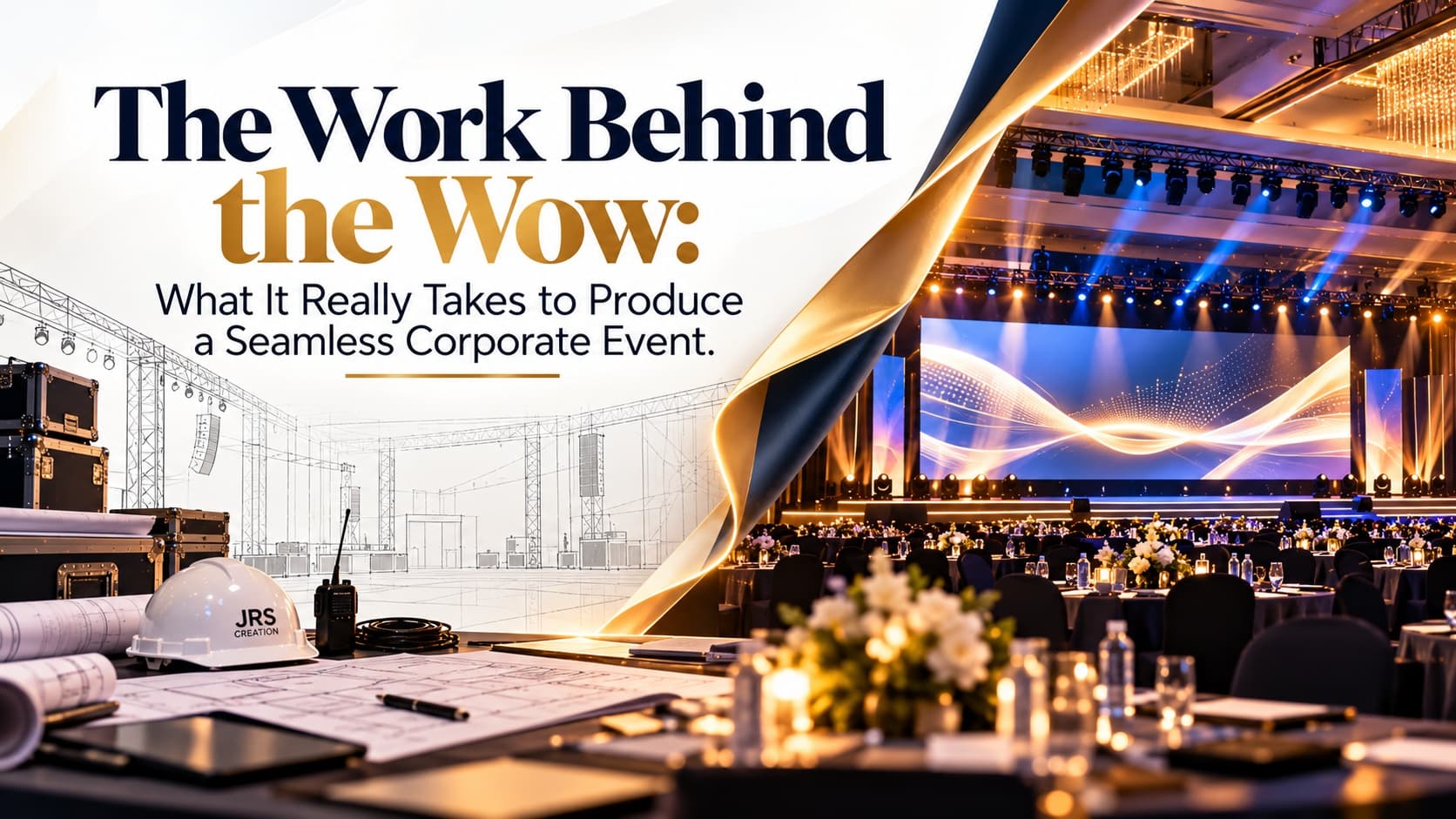
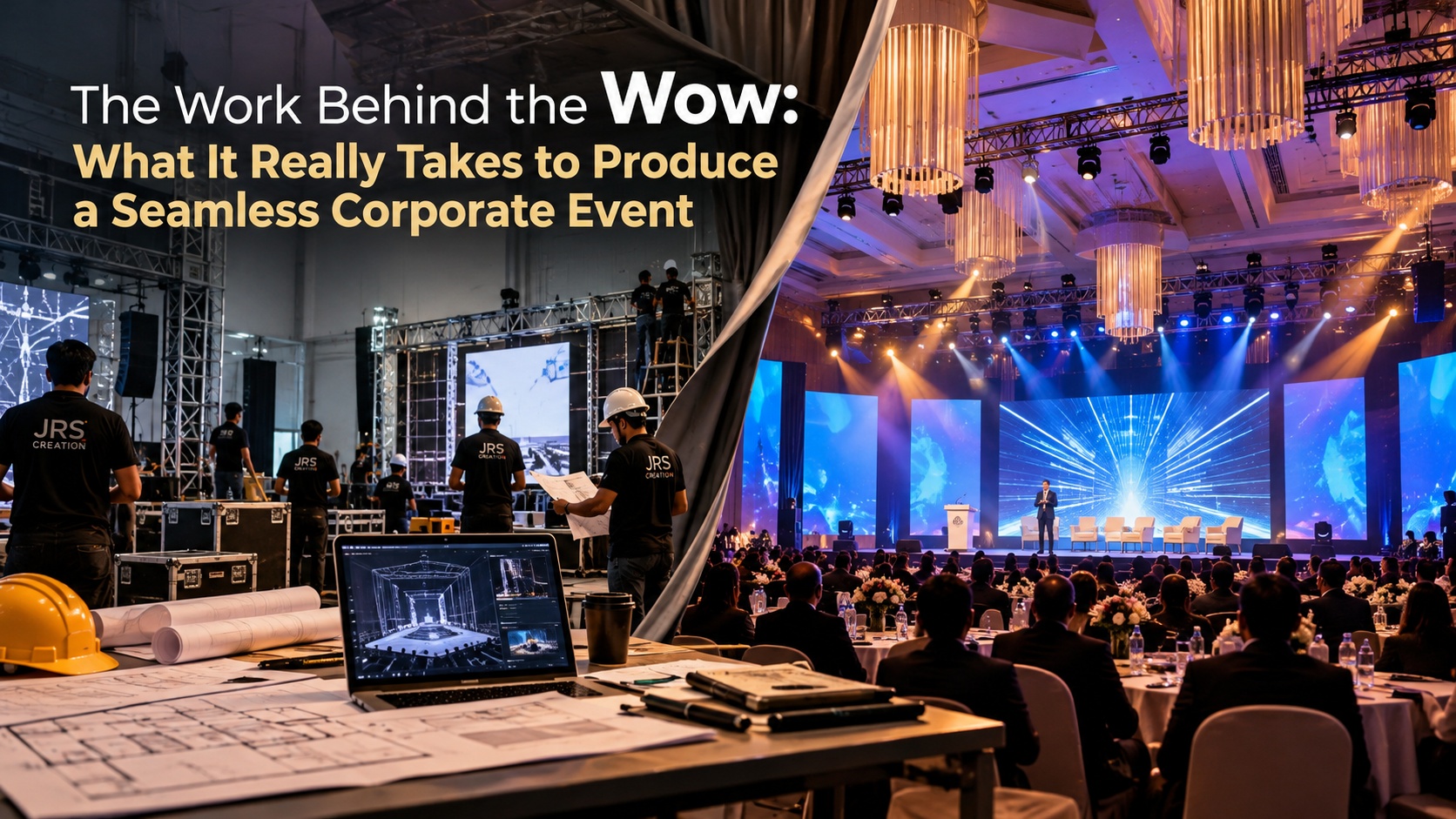
The Work Behind the Wow: What It Really Takes to Produce a Seamless Corporate Event
When guests enter a corporate event, they see the finished experience: an impressive stage, carefully designed lighting, clear visuals, welcoming spaces and a programme that appears to move effortlessly from one moment to the next.
What they rarely see is everything that happened before the doors opened.
Behind a well-executed event are countless decisions about space, materials, technical requirements, schedules, people and practical constraints. A stage must do more than look impressive. Lighting must support visibility and atmosphere. Audio must work across the venue. Fabrication must fit the design, the site and the installation window. Every component needs to come together at the right time.
That is the work behind the wow.
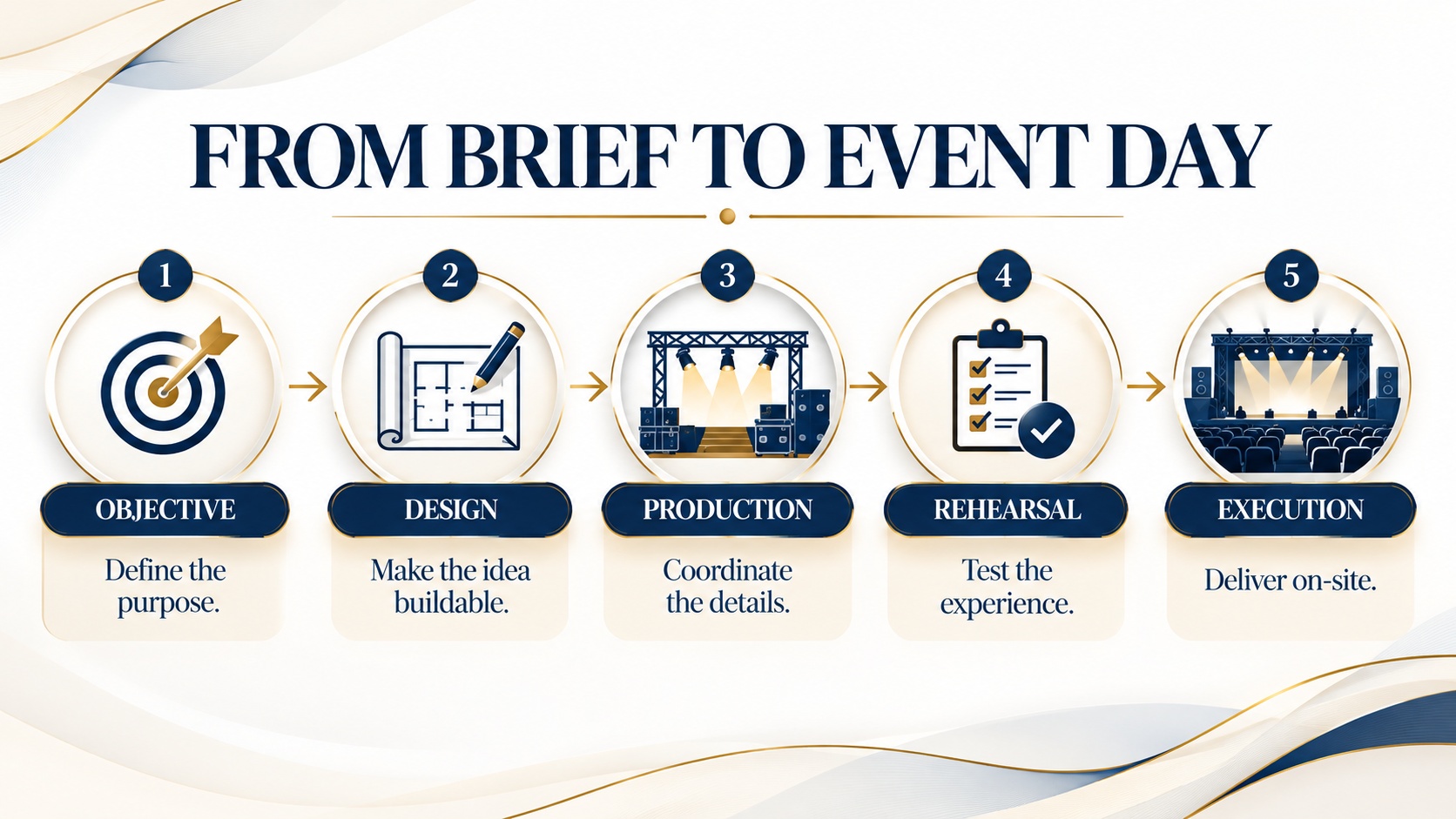
1. Every Great Event Begins Before the First Sketch
Corporate event production should begin with questions, not decorations.
What is the organisation trying to achieve? Is it recognising employees, launching a product, bringing partners together, communicating a strategy or celebrating a milestone? Who will attend, and what should they understand, feel or do during the experience?
These answers influence nearly every production decision.
An employee recognition event may need a stage that makes award recipients the centre of attention. A leadership conference may require clear sightlines, reliable presentation technology and an environment that supports focused communication. A product launch may need display areas and carefully planned visual reveals.
Without a defined objective, event design can become a collection of attractive elements that do not necessarily work together.
2. Translating a Creative Idea into a Buildable Experience
A concept may look compelling on a presentation slide. The next challenge is making it work in a real venue.
This is where creative thinking meets production planning. The team needs to consider the available floor area, ceiling height, audience capacity, venue restrictions, movement routes, sightlines and technical requirements.
A design that works in a spacious convention centre may need substantial changes in a smaller ballroom. A large LED backdrop may affect stage proportions, structural planning and power requirements. A scenic installation may need to be divided into transportable sections so it can be assembled within the venue's permitted access hours.
The objective is not to compromise the idea unnecessarily. It is to develop a practical solution that preserves the intended experience while accounting for the conditions in which it must be delivered.
Good production planning makes creativity executable.
3. Fabrication: Where the Design Becomes Physical
Stage elements, branded structures, display units and scenic features give an event its physical identity. But fabrication involves much more than constructing something that looks right from the front.
Dimensions, materials, finishes, joints, stability, transportation and installation methods all matter. Components need to be produced with the final venue and assembly process in mind.
For example, a stage backdrop may look seamless in a rendering, but the actual build must account for panel joins, cable access, lighting positions and how each section will be moved into place.
Finishes also need to work under event lighting. A material that looks subtle in daylight may reflect too much light under powerful fixtures. A brand colour may appear different across printed surfaces, painted structures and LED screens.
These details are easier to resolve during planning and production than during the final hours before an event.
4. Technical Production: The Systems the Audience Depends On
Audio, lighting, LED screens, presentation systems and control equipment are not separate decorations. They are part of the experience itself.
A speaker's message loses impact if the sound is unclear. Important information becomes difficult to follow when slides are unreadable. Poorly coordinated lighting can make a stage feel flat or leave presenters inadequately illuminated.
Technical production therefore needs to be planned around the programme and the venue.
This can include assessing sound coverage, choosing appropriate display configurations, positioning lighting, coordinating playback systems and confirming how presentations, videos and other show elements will be operated.
Technical requirements vary by event. The right solution depends on the venue, audience size, programme, content and available infrastructure—not simply on choosing the largest screen or the most elaborate lighting arrangement.
5. The Run Sheet: Making Every Moment Work Together
An event can have excellent design and reliable equipment yet still feel disorganised if its schedule is unclear.
A production run sheet helps translate the programme into a coordinated sequence of activities. Depending on the event, it may cover guest arrival, opening remarks, presentations, video playback, award announcements, speaker movements, stage changes and closing moments.
It should make responsibilities and timings clear to the relevant teams.
If an award recipient needs to be ready before their name is announced, that movement needs to be considered. If a presentation requires a video followed by a speaker, both elements must be prepared in the correct order. If a stage needs to change between programme segments, the time and people required for that change must be built into the schedule.
The run sheet is not merely an agenda. It is a working coordination document that helps people understand how their tasks fit into the wider event.
6. On-Site Setup: Where Planning Meets Reality
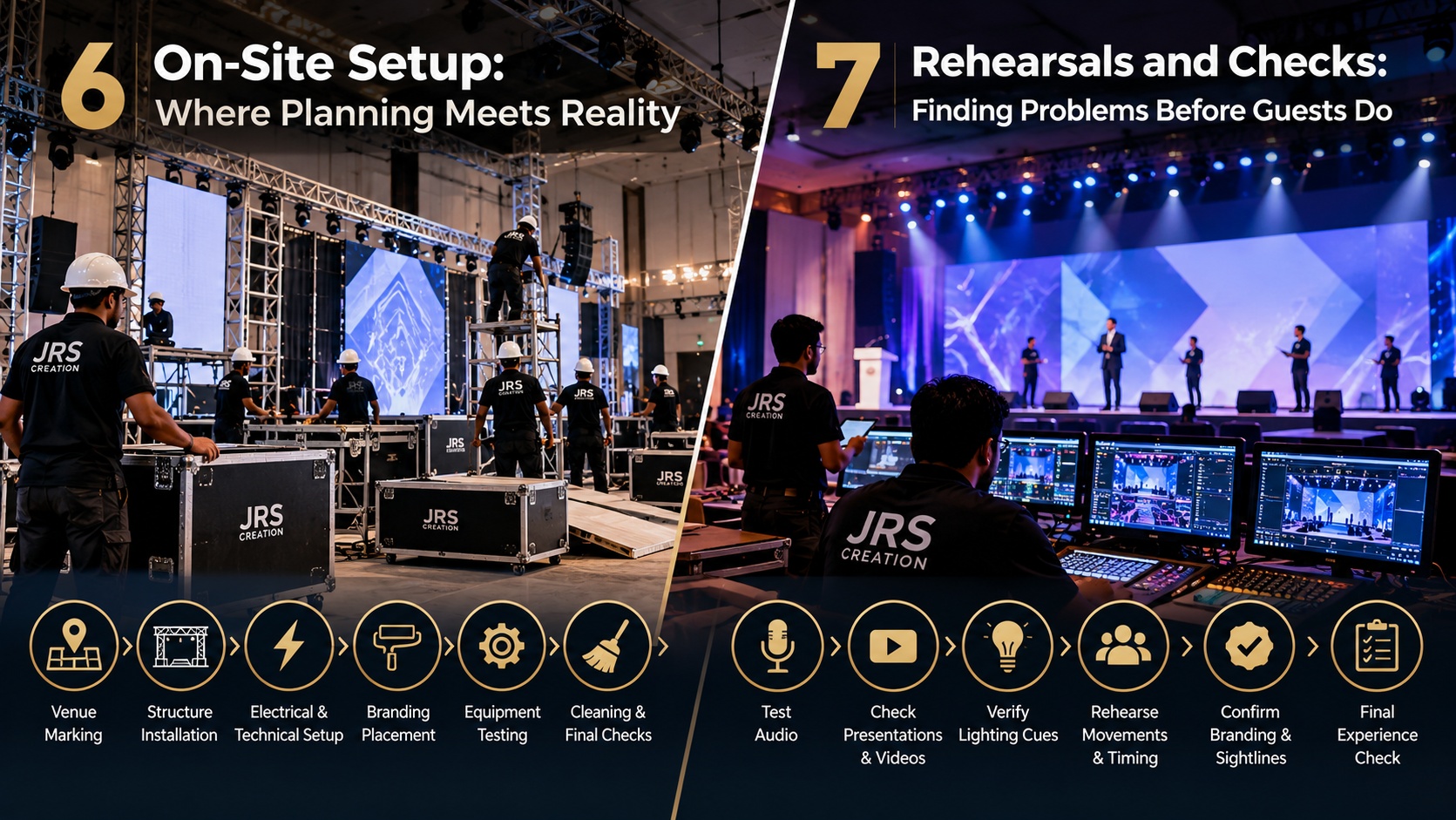
The venue is where production plans are tested against real conditions.
Access may be limited to specific hours. Deliveries may need to follow a designated route. Other activities may be taking place nearby. Equipment may need to be moved through service corridors, and installation teams may have to work within strict venue rules.
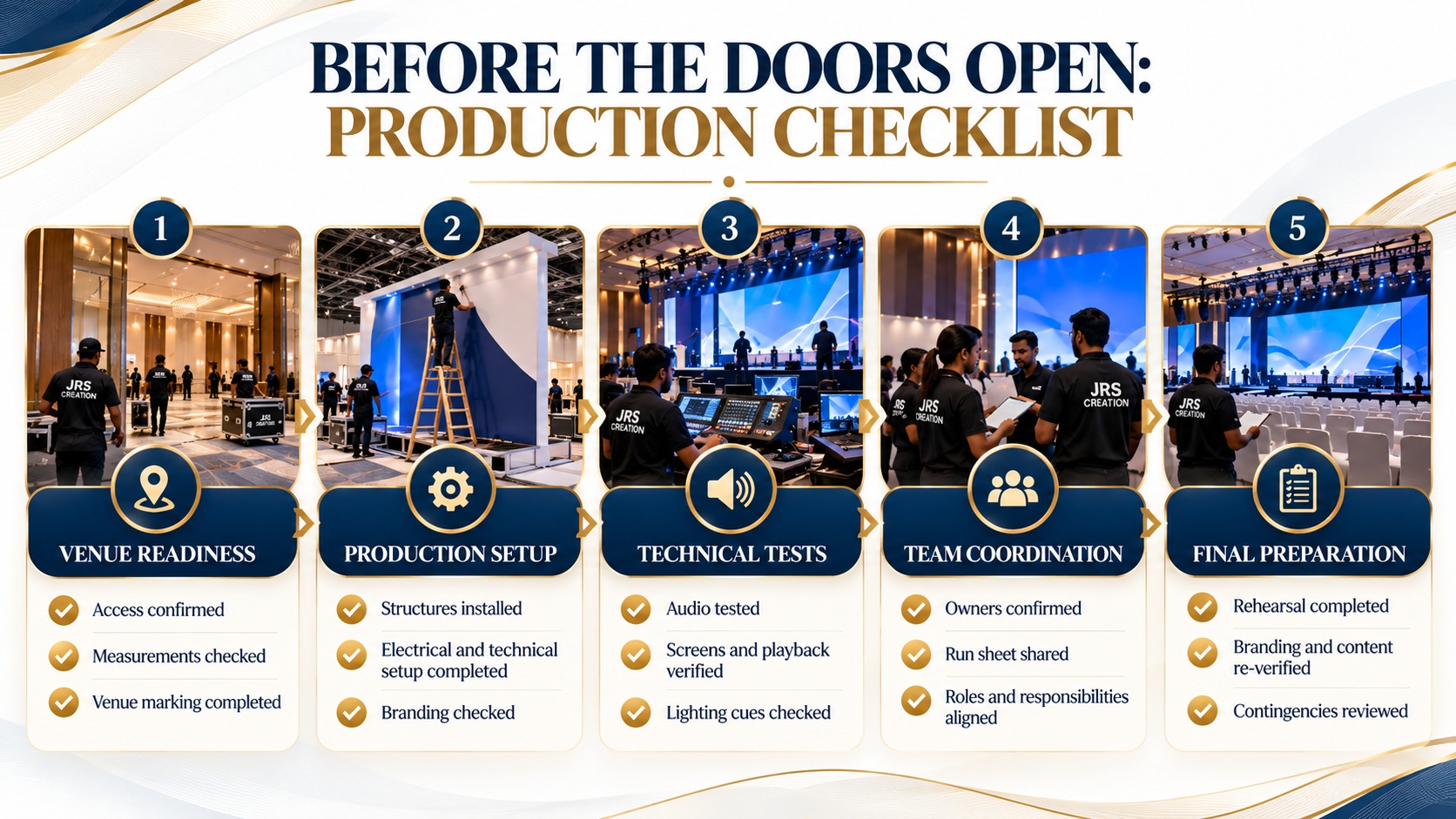
A practical setup sequence helps teams coordinate these moving parts. Depending on the project, it may include venue marking, structure installation, electrical and technical setup, branding placement, equipment testing, cleaning and final checks.
The sequence matters because some tasks depend on others. Final lighting adjustments cannot be completed properly before the relevant structures and fixtures are in position. A screen cannot be fully checked until its content and playback system are ready.
The goal is to complete the necessary work safely, systematically and within the agreed access window.
7. Rehearsals and Checks: Finding Problems Before Guests Do
A completed setup is not the same as a production-ready event.
Pre-event checks help teams identify problems while there is still time to address them. These may include testing microphones, checking presentation files, verifying video playback, confirming lighting cues and reviewing transitions between programme segments.
Where appropriate, presenters and key participants can rehearse their movements and timing. The team can also verify that branding is correctly positioned, audience sightlines are acceptable and essential equipment is functioning as expected.
A useful final check asks more than whether each item is switched on. It asks whether the complete experience works as intended.
Can attendees see the content? Can speakers be heard clearly? Does the next programme element start when expected? Do the people responsible know what they need to do?
Rehearsals cannot eliminate every possible disruption, but they can reduce avoidable surprises.
8. Coordination: The Invisible Connection Between Teams
Corporate event production often involves several functions working in parallel: creative planning, fabrication, technical teams, venue representatives, suppliers, programme coordinators and client stakeholders.
The challenge is not simply getting each team to complete its own task. It is ensuring that the tasks connect.
A change to the stage design may affect screen placement. A programme change may affect lighting cues or equipment requirements. A delayed delivery may influence the installation sequence. If these updates do not reach the right people, a small change can create several downstream problems.
Clear ownership, agreed communication channels and timely updates help teams respond without losing sight of the overall plan.
This is also why responsibility for key decisions should be clear. When everyone assumes that someone else is handling a detail, that detail can easily be missed.
A coordinated production process makes dependencies visible before they become last-minute issues.
Contingency Planning: Preparing for What Might Change
Even a carefully planned event operates in a changing environment.
A presentation file may need replacing. A speaker may arrive late. A piece of equipment may require a backup solution. A schedule may change because a session runs longer than expected.
Contingency planning begins by identifying the risks that matter most to the particular event and deciding how the team should respond.
Depending on the production, this may involve backup presentation files, spare essential equipment, alternative sequencing, clear escalation contacts or additional time for critical setup activities.
Not every risk requires an elaborate backup system. The appropriate response depends on the potential impact, the likelihood of disruption and the resources available.
The important point is to make decisions before pressure is at its highest. A team with agreed alternatives can respond more calmly than one trying to establish responsibility and solutions in the middle of a live programme.
10. Measuring the Work Beyond Event Day
A smooth event is valuable, but the production process should not be evaluated only by whether the audience enjoyed the final result.
A post-event review can examine what worked, what required rework, whether setup and rehearsal milestones were met, which coordination issues arose and what should change for the next project.
Client feedback and audience responses can provide additional insight. For business-focused events, the review may also consider whether the experience supported its original objectives—for example, clearer communication, employee recognition, product understanding or more meaningful conversations.
The right measures depend on the event's purpose. Attendance alone rarely explains the complete picture, and a visually impressive production should not automatically be treated as proof of business impact.
Documenting lessons learned helps teams improve their planning, processes and execution over time.
What to Look for in a Corporate Event Production Partner
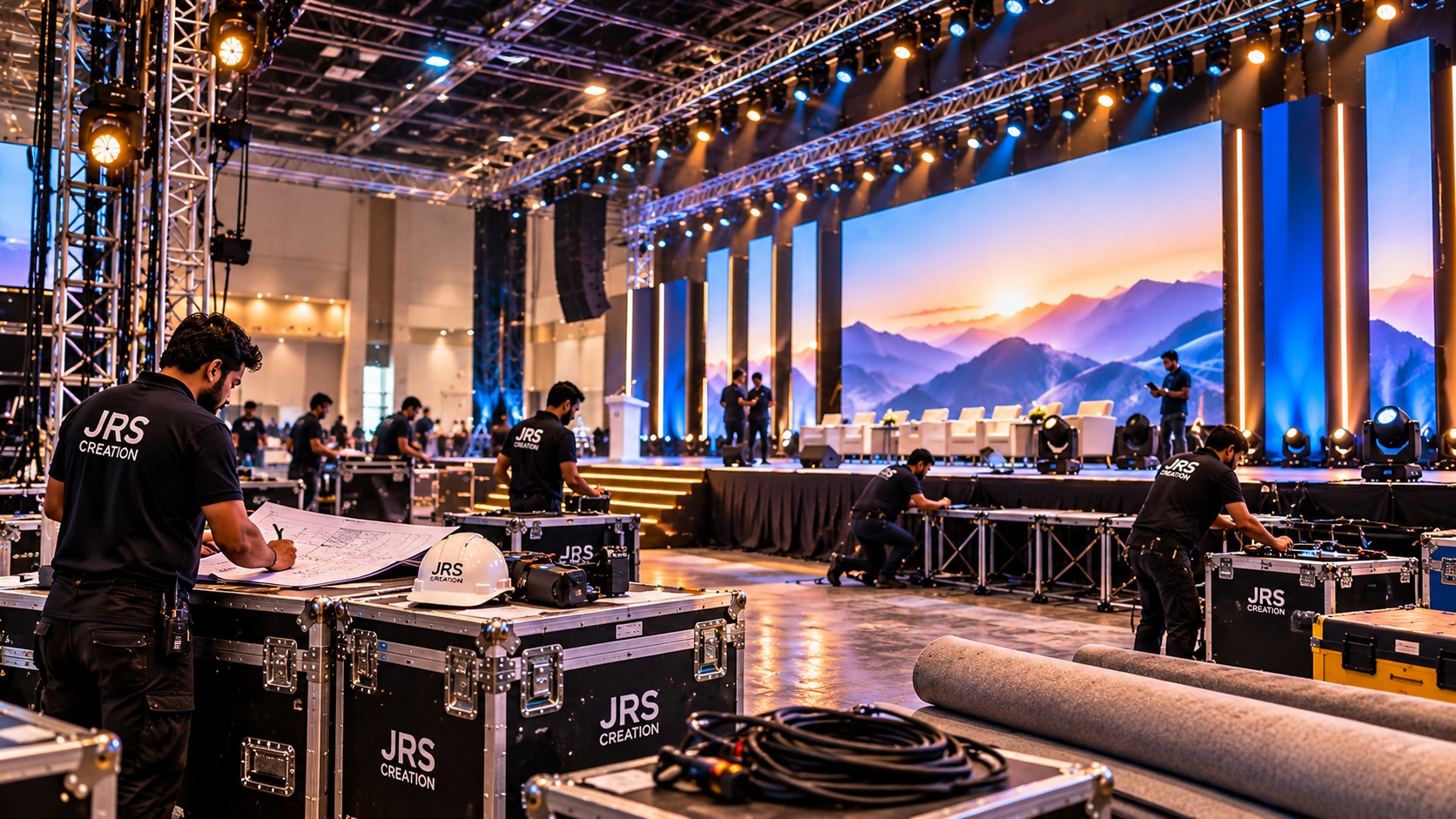
When evaluating an event production partner, look beyond the final photographs or creative presentation. Ask how the proposed experience will be delivered.
Consider whether the team:
Understands the event objective and audience before proposing a design.
Can explain how the concept will work within the venue's practical constraints.
Plans fabrication, technical requirements and installation as connected activities.
Defines responsibilities, communication channels and key milestones.
Includes appropriate testing, rehearsals and contingency considerations.
Can explain how changes will be managed during preparation and on-site execution.
Reviews the outcome and captures useful learning for future projects.
The right partner should be able to discuss both the visible creative elements and the practical work required to bring them to life. The scope of responsibility should also be clear, including which services are handled directly and which depend on specialist suppliers or venue teams.
How JRS Creation Approaches Event Experiences
At JRS Creation, the finished event environment is only one part of the picture. The planning, production details and on-site coordination behind it are equally important to delivering an experience that reflects the client's brief.
For corporate events, employee recognition programmes, conferences and exhibition environments, the production approach should connect the intended experience with the practical requirements of the venue, design, fabrication and event schedule.
Every project has its own objectives, constraints and technical needs. A thoughtful process helps identify those requirements early, align the people involved and prepare the elements that need to come together on the day.
If you are planning a corporate event, start by defining what the experience needs to achieve—and then build the production plan around that objective.
The Final Takeaway
The most memorable corporate events often feel effortless to the people attending them. That feeling is rarely accidental.
It is built through clear objectives, practical design decisions, careful fabrication, dependable technical preparation, rehearsals and coordination between teams. Each element supports the next, creating an experience that feels connected rather than assembled from separate parts.
The audience sees the wow.
The production process makes it possible.
Planning a corporate event? Talk to JRS Creation about your event requirements, production scope and the experience you want to create. https://www.jrscreations.net/contact
FREQUENTLY ASKED QUESTIONS
What is corporate event production?
Corporate event production is the process of planning and delivering the physical, visual and technical elements of a business event. Depending on the project, this can include stage design, fabrication, lighting, audio-visual systems, setup, rehearsals and on-site coordination.
What is the difference between event planning and event production?
Event planning generally focuses on the event's objectives, programme, logistics and overall arrangements. Event production focuses on translating the plan into a working experience through design, technical systems, physical builds and execution. The two functions often overlap, depending on the project scope.
Why is a technical rehearsal important?
A technical rehearsal helps teams test equipment, content playback, lighting cues, audio and programme transitions before guests arrive. It provides an opportunity to identify and resolve avoidable issues before the event begins.
How early should corporate event production begin?
The timeline depends on the event's scale, venue, design complexity, fabrication needs and technical requirements. Events involving custom-built structures, complex staging or multiple programme elements generally require more preparation than simpler setups. Starting early gives teams more time to confirm requirements and coordinate dependencies.
What should be included in an event production checklist?
A useful checklist may include the event brief, venue measurements and restrictions, approved designs, fabrication requirements, equipment lists, setup schedule, assigned responsibilities, technical tests, rehearsal plan, contingency arrangements and final venue checks. It should be adapted to the specific event rather than used as a generic list for every project.